Best Fun Learning Games like Kahoot (including Free Alternatives)
The top ten alternatives to Kahoot: five for the classroom and five for work. Teachers, trainers, managers, speakers — if you're moving away from Kahoot, this is for you.

November 25th, 2026

Kahoot is so over, what’s out there that’s better (or cheaper, or less bloated, or has X thing that I need)? Here are the top 5 for teachers, and the top 5 for trainers / managers / corporate users.
- Overview — all our recommendations
- Kahoot Alternatives for Corporate
- Kahoot Alternatives for Classroom
- Free options & Pricing overview
Here's our overview
| Software | Made for | Main users | User ratings | Base price | Free limits | Top clients | Ease of use | Our Rating |
|---|---|---|---|---|---|---|---|---|
 Kahoot! | Both | Teachers | G24.6Capterra4.7RedditMixed | $3/mo$36 billed yearly | 40 playersper game, teachers | Getty ImagesNasdaq | out of 5 | 7.8 out of 10 |
 Slides With Friends | Both | Corporate trainers, Teachers, Team leads | G24.8Capterra4.9Reddit Loved | $6/mo(edu)$72 billed yearly | 10 playersper event | Boston UniversityAetna | out of 5 | 9.4 out of 10 |
 Wayground | School | Teachers | G24.9Capterra4.8Reddit Loved | $18/mo$216 billed yearly | 100 students20 saved activities | Arlington ISDOttawa Catholic School Board | out of 5 | 9.0 out of 10 |
 Blooket | School | Elementary teachers, Middle school teachers | G24.9CapterraNo listingRedditLiked | $4.99/mo$59.88 billed yearly | 60 playersper game | None published | out of 5 | 8.6 out of 10 |
 Mentimeter | Both | Speakers, Corporate users | G24.7Capterra4.4RedditMixed | $14/mo$168 billed yearly | Unlimited participantslimited results | Siemens HealthineersUniversity of Sydney | out of 5 | 7.8 out of 10 |
 Slido | Work | Speakers | G24.8Capterra4.8RedditLiked | $17.50/mo$210 billed yearly | 100 participants3 polls per event | CiscoAutodesk | out of 5 | 8.4 out of 10 |
 AhaSlides | Both | Trainers, Teachers | G24.7Capterra4.6Reddit Loved | $2.95/mo$35.40 billed yearly | 50 participantsper session | FerreroAbu Dhabi University | out of 5 | 8.5 out of 10 |
 Poll Everywhere | Work | Speakers, Trainers | G24.5Capterra4.5RedditLiked | $10/mo$120 billed yearly | 40 participantsper activity | Cornell UniversityPace University | out of 5 | 6.8 out of 10 |
 Gimkit | School | Teachers | G2No listingCapterraNo listingRedditLiked | $4.99/mo$59.88 billed yearly | 3 game modesrotating; Pro modes 5 players | None published | out of 5 | 7.5 out of 10 |
 StreamAlive | Work | Webinar hosts | G24.7Capterra4.8RedditToo few | $25/mo$300 billed yearly | 5 participantsper session | Rutgers UniversityIndian Institute of Management | out of 5 | 7.1 out of 10 |
I’m going to go into full detail on each of these platforms, below. The goal of this post is for you to walk away with a basic understanding of each tool and a clear knowledge of which is the right fit for you.
So if you’re here already knowing what you want to do (like, “I need to run a live poll with my audience”) I can point you to the right platform based on specific functionality. Or if you’re here being all “I have a town hall coming up. what do?” I’ll lay out your options. I’ve gone through dozens of tools, found the best of the best specifically for teachers & trainers, and previous Kahoot users. It was tough, but I narrowed it down to just a few.
Why trust me: I’ve been in the interactive event space for almost a decade, I talk to teachers and presenters *every day* about what they need.
I have personally used each and every one of these tools live.
Let's dive in:
Kahoot Alternatives for Corporate
1. Slides With Friends
Overall: Slides With Friends for education is in some ways a better option than Kahoot for the average classroom. It lets you run interactive lessons, play icebreakers, play review games, or run quizzes / exams, all through a pretty simple "slide deck" setup. You can create your own lessons or choose from pre-made templates, all in a PowerPoint-type interface.
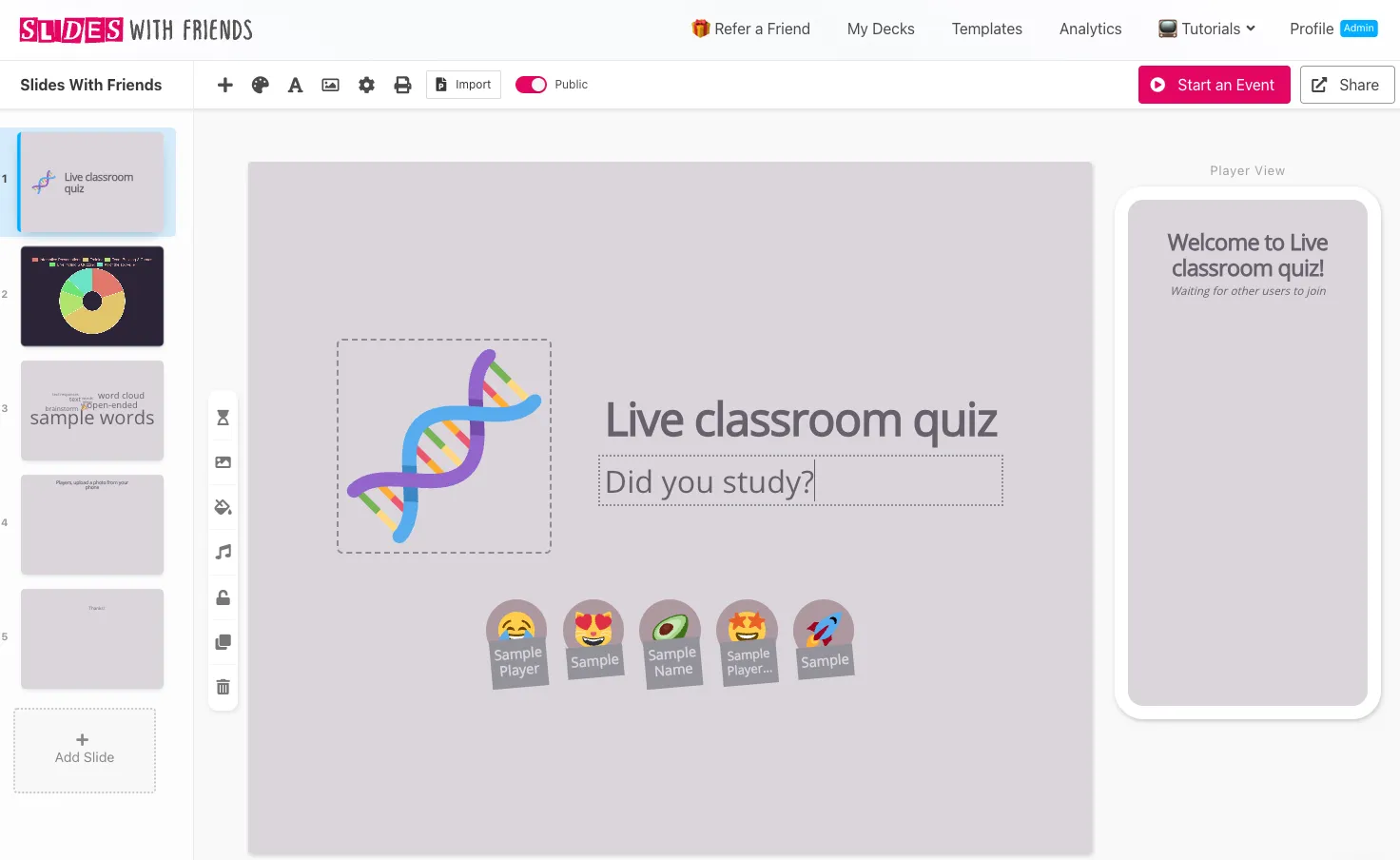
- Who for: It’s super versatile, but best for three types of people: 1. Trainers, managers, team leaders running meetings or trainings. 2. Teachers / professors running classes. And 3. speakers / event runners talking to audiences. True to the name, the vibe is friendly and accessible, with fun event ecosystem elements like emoji avatar for players, soundboard reactions, and more.
- What for: This is for when you want your group to both see your content like a ppt presentation and interact / respond during it. Live polling, quizzing/assessment, icebreakers/games, Q&A, and more.
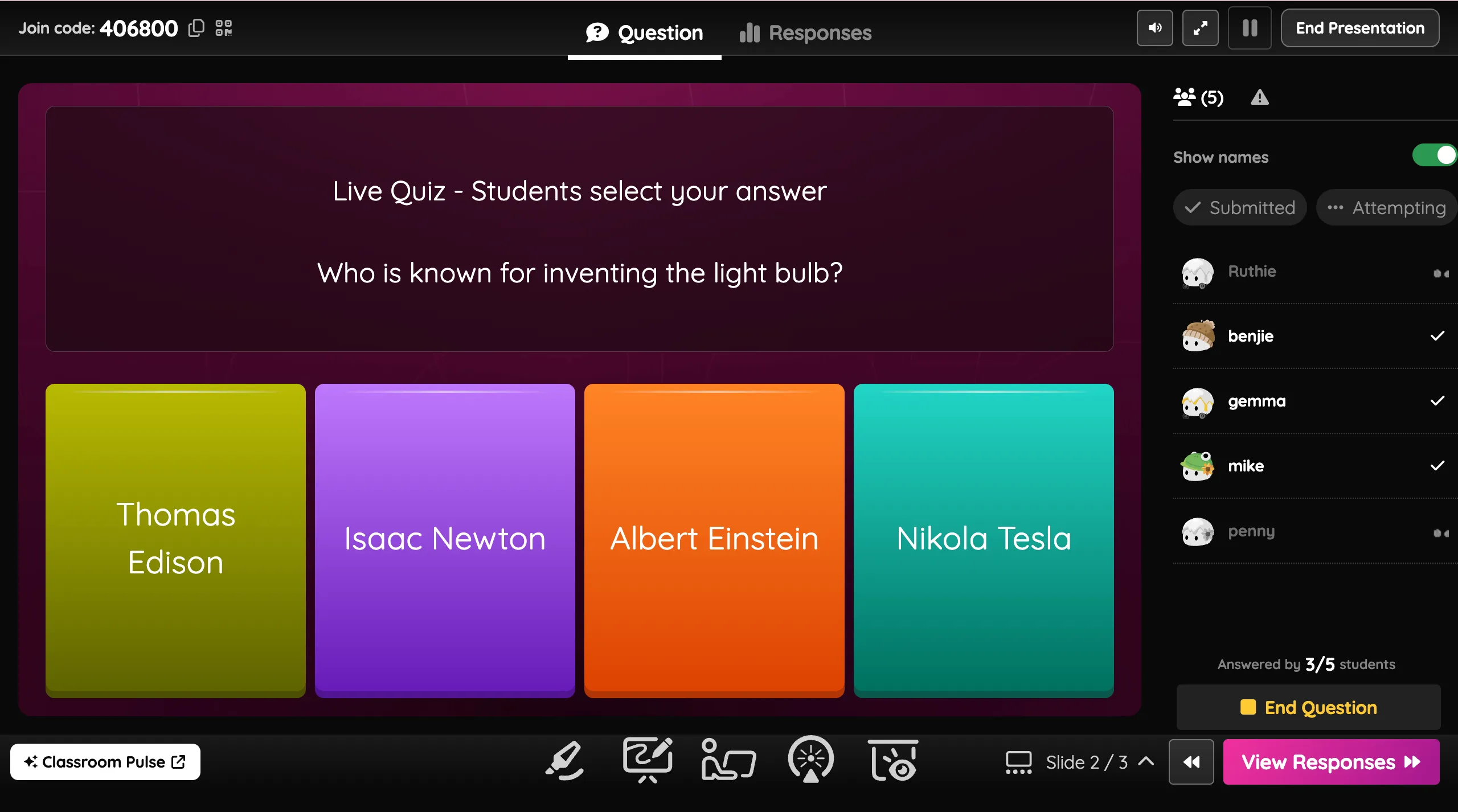
So if you’re running a meeting or all hands or town hall where you want to run an icebreaker, brainstorm, or go over Q3, this is ideal. Or if you want to run a quick, live, pop quiz with your classroom. Or if you are doing the keynote and want to engage everyone (and get real like instant feedback). - What is: It’s one of the best interactive presentation builders we’ve found (biased because I’m building it — I’m designing it purposefully to be better than what’s out there). You can create your entire presentation in one spot, like your whole ppt deck, but then build in all the interactions, quizzes, games, etc right in. No more flipping back and forth. There are tons of interactions types, from the basics like multi choice / text answer quizzing, to live polls to wordclouds, to kicky interactions like a “cards against humanity” type players-vote-on-eachother’s-answers game.
- Ratings: 4.8 on G2, 4.9 on Capterra, and I gave it a 9.4 (I’m biased). Reviewers mostly talk about how easy it is, lots of team trivia / remote meeting people in there. The thing they ask for is more control over the slide look and feel.
- Standout feature: nothing fun is locked. Every interaction type is in the free plan, the polls, the wordclouds, photo sharing, the players-vote-on-eachother’s-answers game, all of it. Also if you only have one big event you can get a one-month pass ($35 for up to 50 players) and skip the subscription.
- Biggest drawback: small free groups. You can have 10 players before upgrade, which is less than most of the tools here.
- The good: So many things. There’s the clean & obvious UI that (if you know ppt or any other slide deck builder) you’ll recognize and understand right away. There’s the designer — make your slides look exactly like you want them (unlike Kahoot, which pretty much looks the same every time).
- The interactions and events themselves: fun, easy, seamless, and designed to amp up engagement (while still doing real work & getting real data).
- The tracking & analytics: follow trainees across events and over time; follow deck ratings over time.
- The moderator tools: see what’s going to happen before it happens (and remove content you dont want displayed). So many more things. - The bad: Smaller groups before upgrade than some competitors. Some nice to haves are still in progress / not available, including a “reorder answer options” slide, and “join in as a team” (rather than each device being an individual player). The AI additions are minimal still.
- What users say:
- “We’ve done Slides with Friends a few times & it’s always fun. You can build your own slide deck or thru have premade decks (like Slides Against Humanity, but HR friendly).” — r/remotework
- “Slides With Friends is fine for QR runs, but for a more professional tone I’ve had better luck keeping everything inside the deck” — r/Training - The pricing: It’s unlimited events, unlimited interactions, and pretty much the whole tool for free. The only time you have to pay is if you want: larger groups (more than 10 players), or fuller analytics. Starts at $8/mo, $96/yr billed yearly, for up to 50 players (teachers: $6/mo, $72/yr).
(These price points are from November 2026 — dollar amounts change so often, so check the pricing page before you buy.)

2. Mentimeter
Overall: One of the oldest of the bunch, this is a good corporate option especially if you need a lot of settings power.
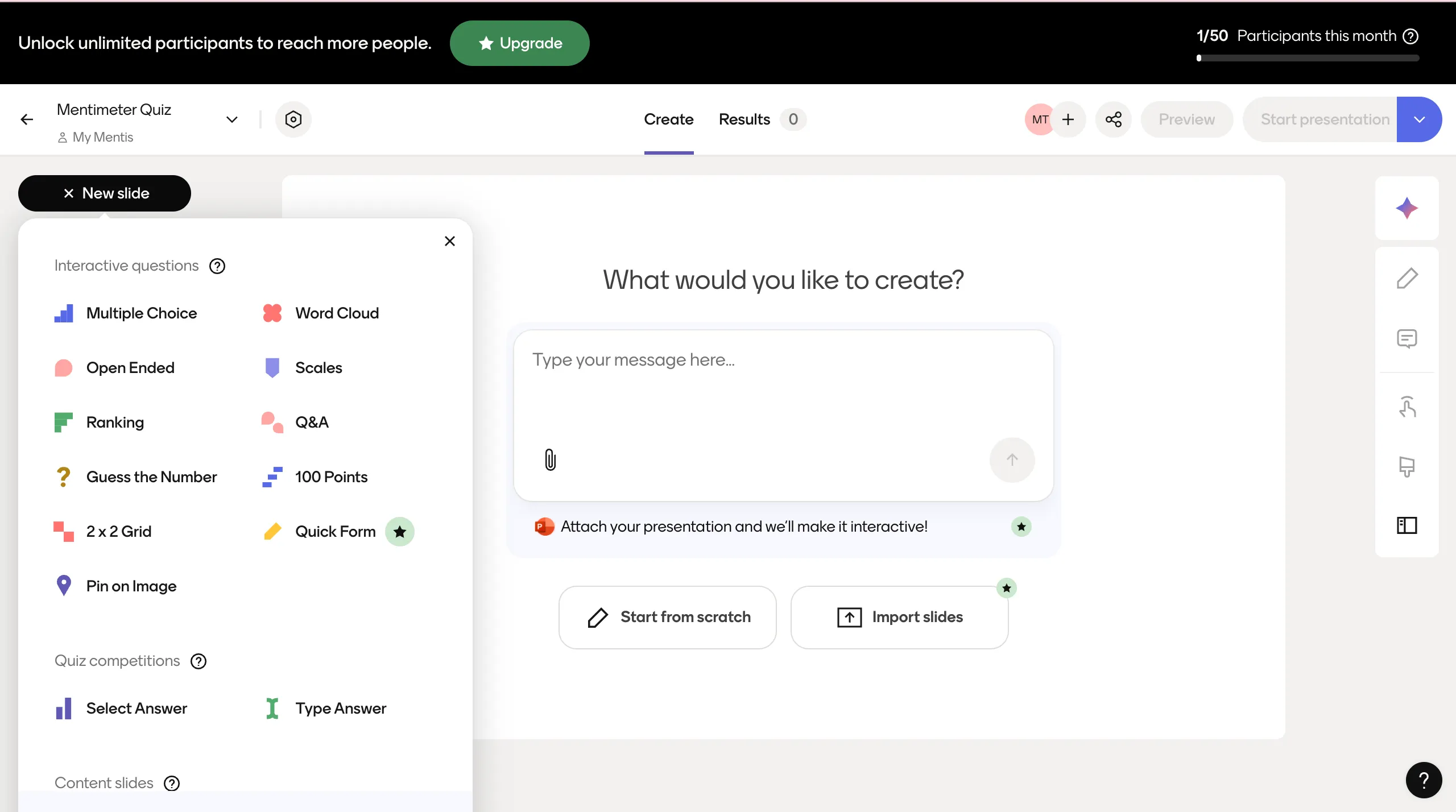
- Who for: The training / speaking / consulting professional. This is probably your best “I’m wearing a suit talking to people and want to look engaging — but not too exciting” tool option. So if you’re planning to wear hard pants for your presentation, may I suggest Mentimeter.
- What for: Whenever you’re doing something corporate or serious where emoji just wouldn’t be the right feel, like a town hall where you’re announcing a round of layoffs and want to get a pulse on the reaction, this is a good option. If you need an LMS integration or something else a little larger-scale / niggling, also a good choice.
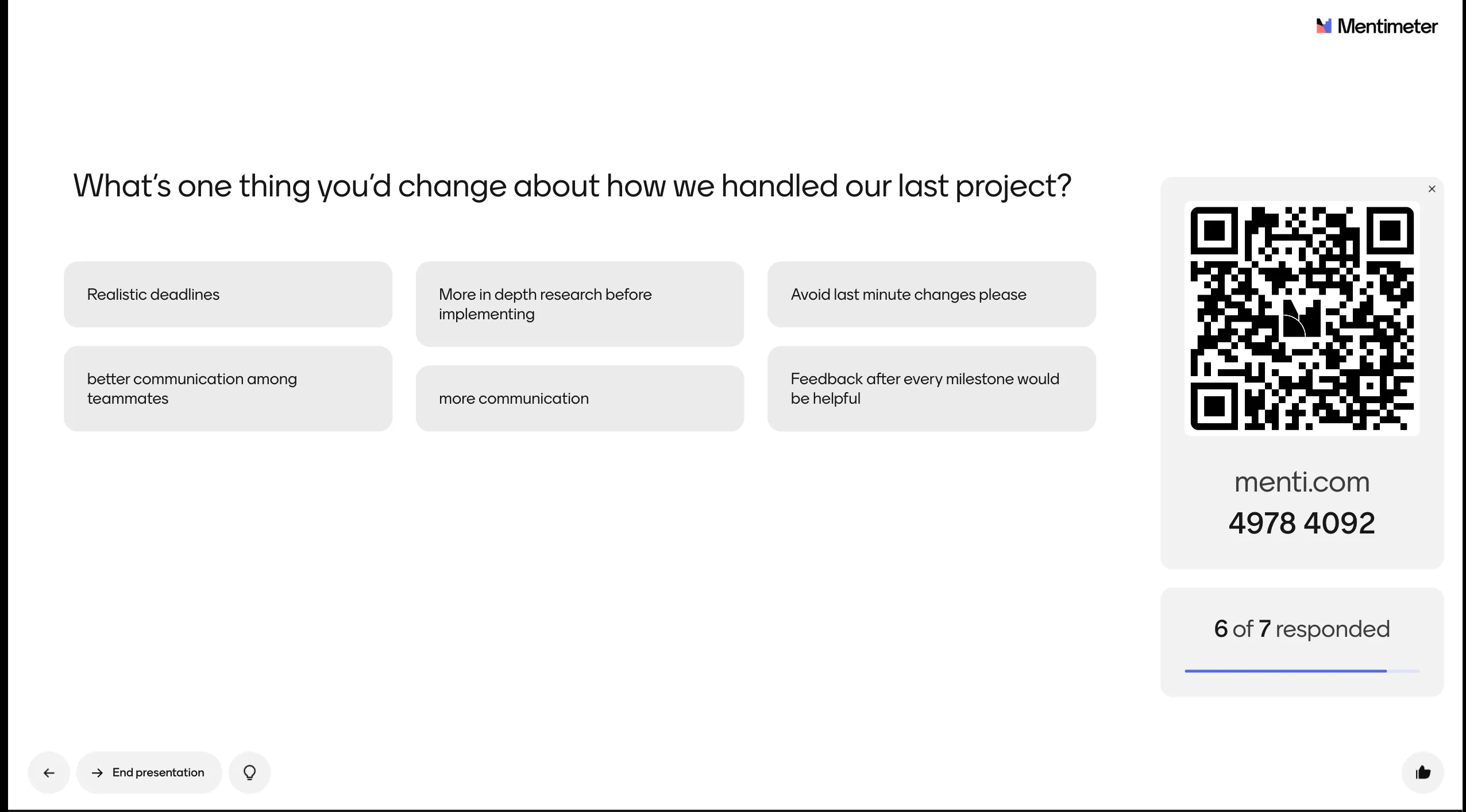
- What is: It’s got all the integrations (ppt, Teams, zoom, etc) and interactions (multichoice/text response, polls, wordclouds, rankings, etc) in a business-forward feel.
- Ratings: 4.7 on G2, 4.4 on Capterra, and we gave it a 7.8. Reviewers like that it’s fast to set up and gets a quiet room to respond. The unhappy ones are mad about stuff being locked behind paid plans, or about templates / refunds (there’s a bunch of those from 2024). Reddit is split, trainers like it, the AV and event tech people who have to run it on show day really do not.
- Standout feature: the settings power. There’s a setting for pretty much anything, a ton of slide types, and if you’re a big org they’ll hook into your LMS / SSO etc on the top tier.
- Biggest drawback: you pay per presenter, for the whole year. And the things you’d want for a real event (moderating the Q&A, your own branding, co-editing) are on Pro, so if you have a few people presenting this gets expensive fast.
- The good: This is one of the oldest options out there — it’s mature software for sure, and they’ve been around long enough to have added all the bells and whistles requested over the years. The design is nice, the tech gets spruced up not irregularly, and it just works.
- The bad: It’s a little bloated and if it’s old, yeah, you can tell it. They have a mix between an old fashioned wysiwyg editor and on-slide editing, and not a lot of designability or moveability. It’s not gonna look like your slide, it’s gonna look like their slide. There are settings buried in settings all over the place. You can do a lot, but you have to climb a bit to know how.
- The AI: They have one of the better AI deck generators: the UI is basically a chatbot, and then it calculates and builds based on your prompts.
- What users say:
- “Mentimeter.com. Excellent with tons of options and great graphics. You can use in PPT but I often put the QR code on my ppt slide … That way, I know for sure that it won't crash ppt” — r/powerpoint
- “Slido PPT plug in works. Menti PPT plug in does not.” — r/VIDEOENGINEERING - The pricing: New accounts (made after 4 Nov 2026) are free for any number of participants, but you only get to see a limited number of the results. Older accounts are free for up to 50 participants a month. (So, if you’re running one group event with 50 players: free, or if you’re running 2 events with 25 players, still free). Once you hit that monthly limit (or want all your results), it’s an upgrade to keep running events: $14/mo, $168/yr billed yearly, for one host and unlimited players (teachers: $11/mo, $132/yr). Yearly only, no month to month.
3. Slido
Overall: this is a different vibe but super powerful if you're running larger lectures, town halls / meetings, or Q&A sessions. Not great for creating a "presentation" or lesson deck.
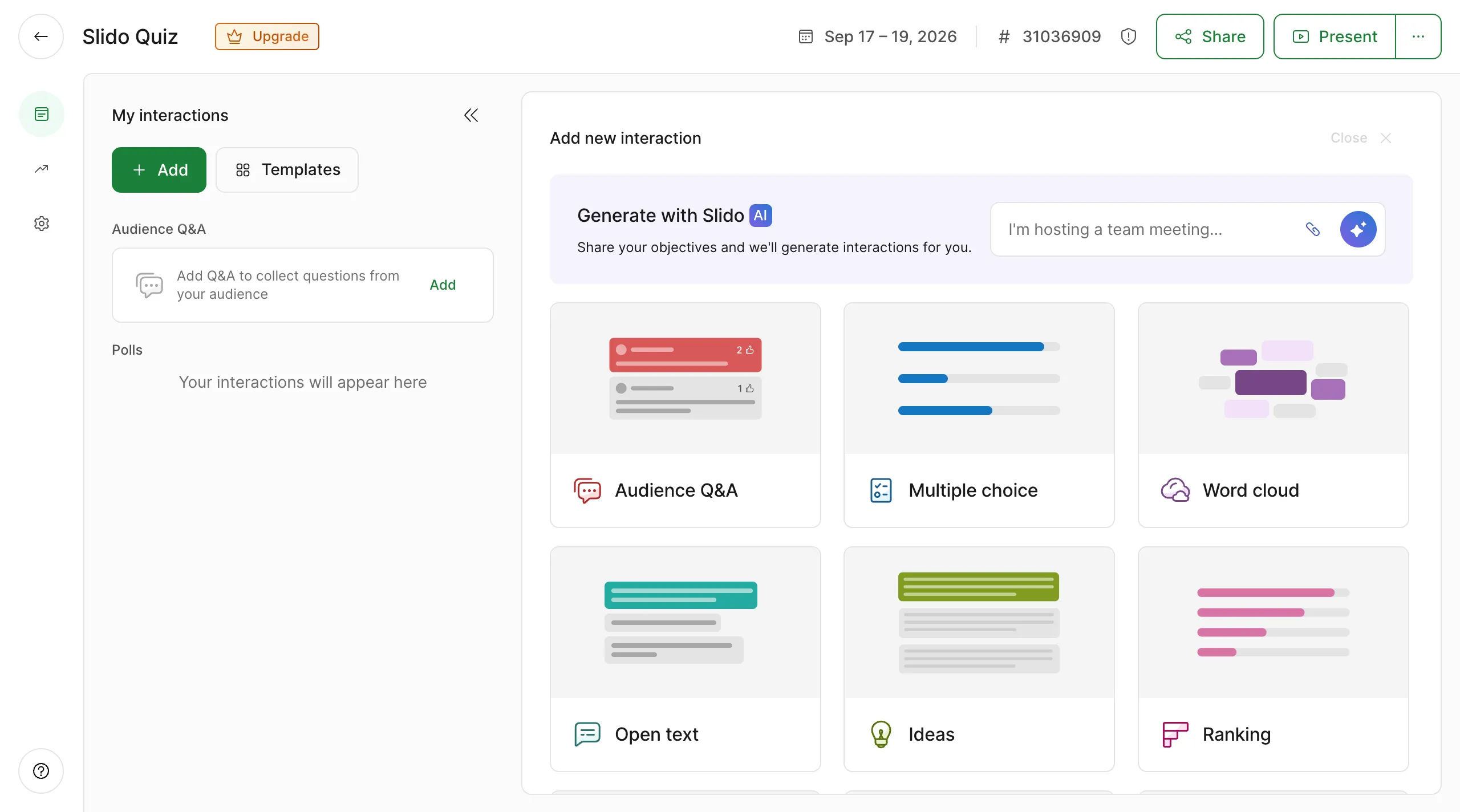
- Who for: Conferences and large group gatherings (panels, town halls, event runners)
- What for: If you want to do a Q&A with a huge group — this is your jam. so if you’re running a big town hall / all hands, if you’re a speaker at a conference, if you’re doing something up on stage and want to hear&organize questions from your audience.
- What is: the UI / UX here works under a different and more un-standard paradigm: it’s not a deck builder like many of these tools. It’s an event ecosystem. You create an event on your end, your participant joins in, and they see two tabs: one for your Q&A, and one for your “polls” (which are every other interaction type). You can have one of each interaction type, like multichoice quiz, wordcloud, poll, etc, if you want more it’s an upgrade. You can have 3 total interactions before an upgrade, also.
- Ratings: 4.8 on G2, 4.8 on Capterra, and we gave it an 8.4. People like that you scan a QR code and you’re in, and that it lives inside ppt / Teams / Webex. Not a lot of complaining here, mostly that it looks kind of plain. Reddit likes it, internal comms people especially.
- Standout feature: the Q&A. Everyone sends in questions from their phone and then votes on which ones they want answered. It’s what they’re known for and it’s nicely designed. And you get this on the free plan.
- Biggest drawback: no moderation unless you’re on one of the bigger plans. So you can’t approve questions before they go up on the big screen, which for a town hall / all hands is kind of the whole thing.
- The good: This is a different tool, and there’s a learning curve, but it’s nicely designed, and once you get in it’s pretty easy to understand.
- The bad: The learning curve
- The engagement is pretty straightforward — they’re nothing fun or interesting, this is your brass tacks q&a tool.
- No designability at all, this isn’t for making a presentation, it’s for having a Q&A on the side, and it’s going to look like Slido. Little things, like wordclouds — users can’t vote for words, this seems like a missing piece. - The AI: You can see some generated options after giving a prompt, and it can make you a sample event. The quality is so so.
- What users say:
- “Highly recommend Slido! It is my absolute favourite tool and has been a lifesaver during our hybrid town halls.” — r/internalcomms
- “Slido used to be the best but I'd argue Vevox has overtaken Slido for features now. I don't think Slido has had a significant feature update in over a year.” — r/VIDEOENGINEERING - The pricing: Free for giving access to up to 100 respondents, and you can do three polls and one quiz with that group. $17.50/mo, $210/yr billed yearly, for twice the group size and unlimited interactions. If you have staff that’s helping run the event, co-hosts are free. If you want to enable multiple people to host their own events, it’s another $17.50/mo per person (5 people max), or a larger plan at $75/mo, $900/yr that comes with two hosts and moderation. No monthly billing — it’s the year, or $60 for a one-off event of up to 7 days.
4. Poll Everywhere
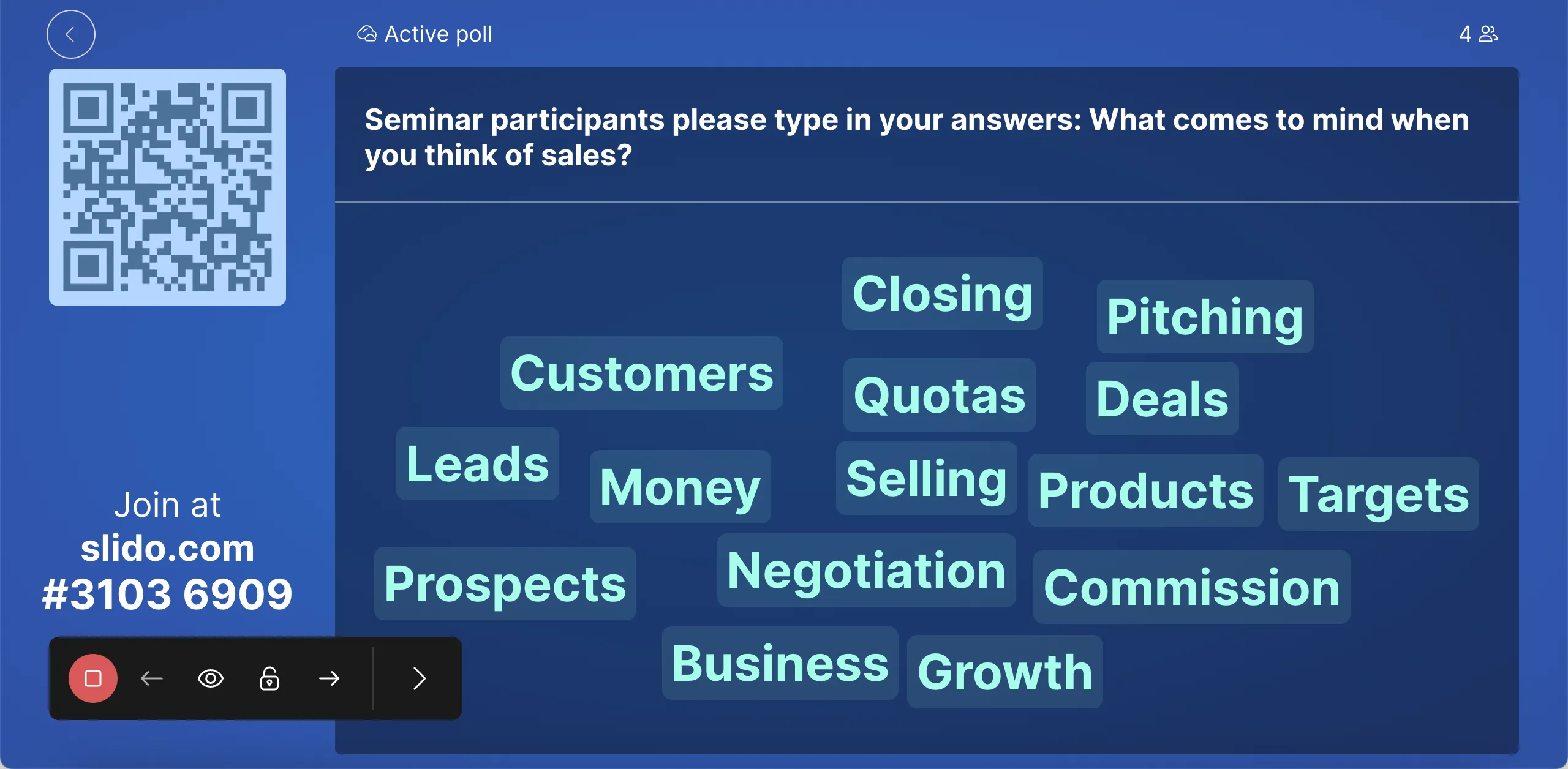
Overall: Poll Everywhere is the simple one, and I like it for that. It can do a lot and throws very few hurdles to entry. You pop in, you add an activity, you turn it live, and you are ready to get responses. No need to build a whole deck or anything.
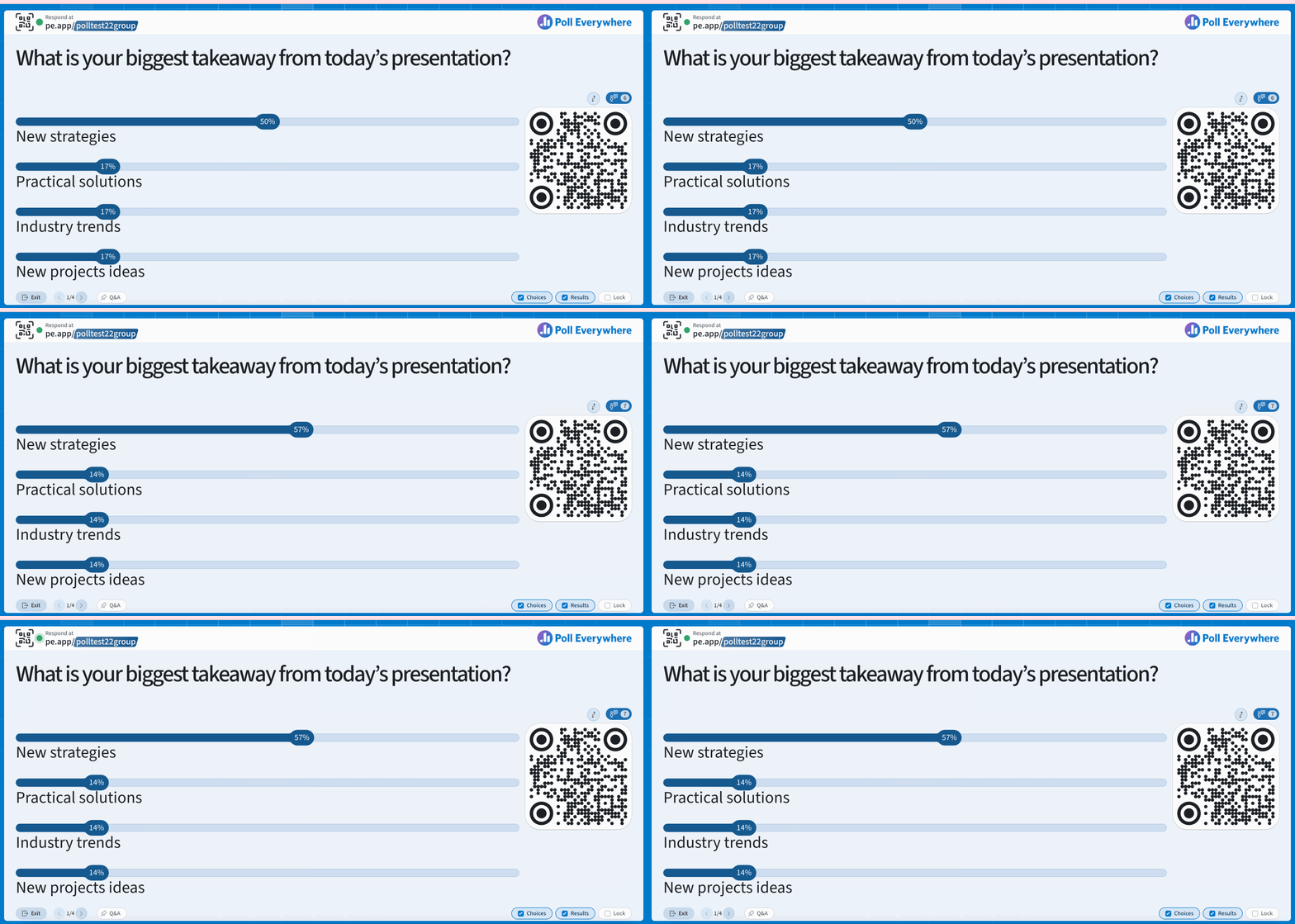
- Who for: Speakers, management, corporate users, university lecturers. There’s not much pre-made content or templates, and very little educational pre-made stuff. This is just your bare-bones “I want to get a poll going right now, and I don’t want to do a ton of prep about it.”
- What for: Meetings, conferences, events. I wouldn’t throw it into a classroom unless it was a larger lecture course. If you want to run surveys with your employees, also a good option, with good analytics (though they require an upgrade).
- Ratings: 4.5 on G2, 4.5 on Capterra, and we gave it a 6.8. People like that it works with the slides they have. The bad reviews are mostly about billing and support, not the polls (you get charged for the year, no refunds, and support is email only). Reddit is mostly professors, they seem happy with it.
- Standout feature: text / SMS responding. People can text in their answer, so they don’t need a browser or an app or even a smartphone. I don’t know another tool on this list that does this.
- Biggest drawback: the price jumps. The first paid plan is cheap, but saving your results is on the next one up and that’s more like $600 a year, and if you want their logo off your polls it’s a grand.
- The good: There are some deep cuts in here — like you can set up text / SMS responding. You can embed your poll, run your poll async, and more. If you’re looking for “polling plus” with details like those, Poll Everywhere is a robust option. Also none of the question types are locked on free, which is nice.
- The bad: It’s older for sure, and they’re halfway through a redesign so right now there are two versions of it floating around (classic and “2.0”) and you have to know which one you’re in. There’s no design or “slide” environment at all, so you’ll be switching around from PPT or whatever your slide deck is, or using their add-in.
- The free plan counts responses not people. So 40 responses is like, 20 people answering two times. - What users say:
- “My university gives us access to PollEverywhere and it seems to work well. Only thing that makes me crazy is that integration into powerpoint on Mac isn't great so I generally just keep a link open and switch in between.” — r/Professors
- “I've used both Poll Everywhere and Slido. Poll Everywhere used to be buggy if using presenter view (not sure now), but it works fine if you're not.” — r/powerpoint - The pricing: Free for up to 40 responses per poll. Ten bucks a month (billed for the year) gets you up to 700. After that it’s on the pricier side for what it is. They have a one-off event option too but it starts at $499.

5. StreamAlive
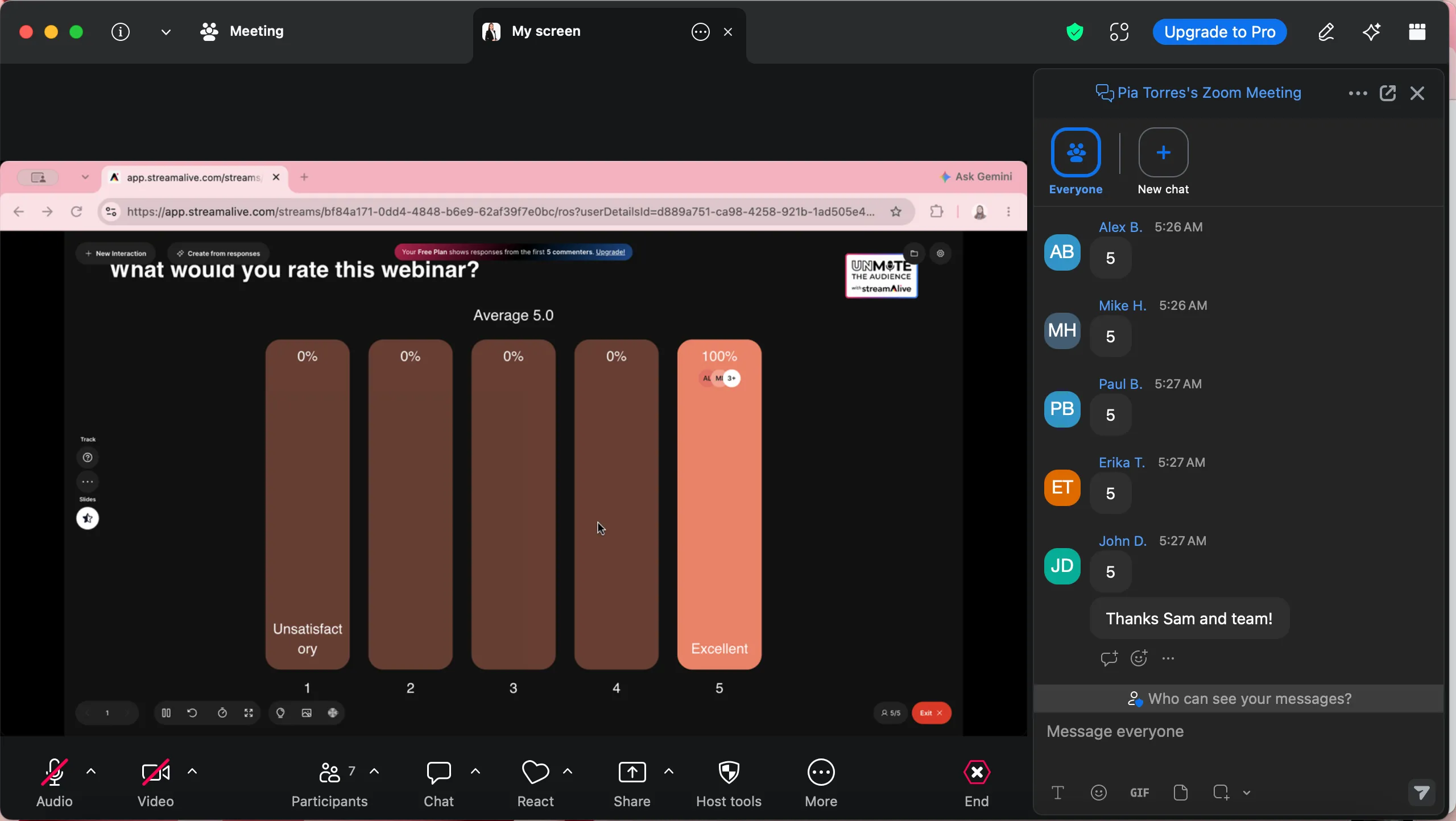
Overall: It's a "type it into the chat" tool that can do some visualizing of chat text. Good for if you want only one screen for users (your zoom screen).
- Who for: You running zoom calls and asking for responses in the chat? This for you. Especially good if you’re doing a webinar or training. This is also good if you don't want your users to require another device in addition to their joined screen.
- What for: Your webinar, your zoom meeting, your MS Teams training sesh, etc: if you’re running it on a video call, and you want people to use the built-in chat on your video call platform, this is a great add on.
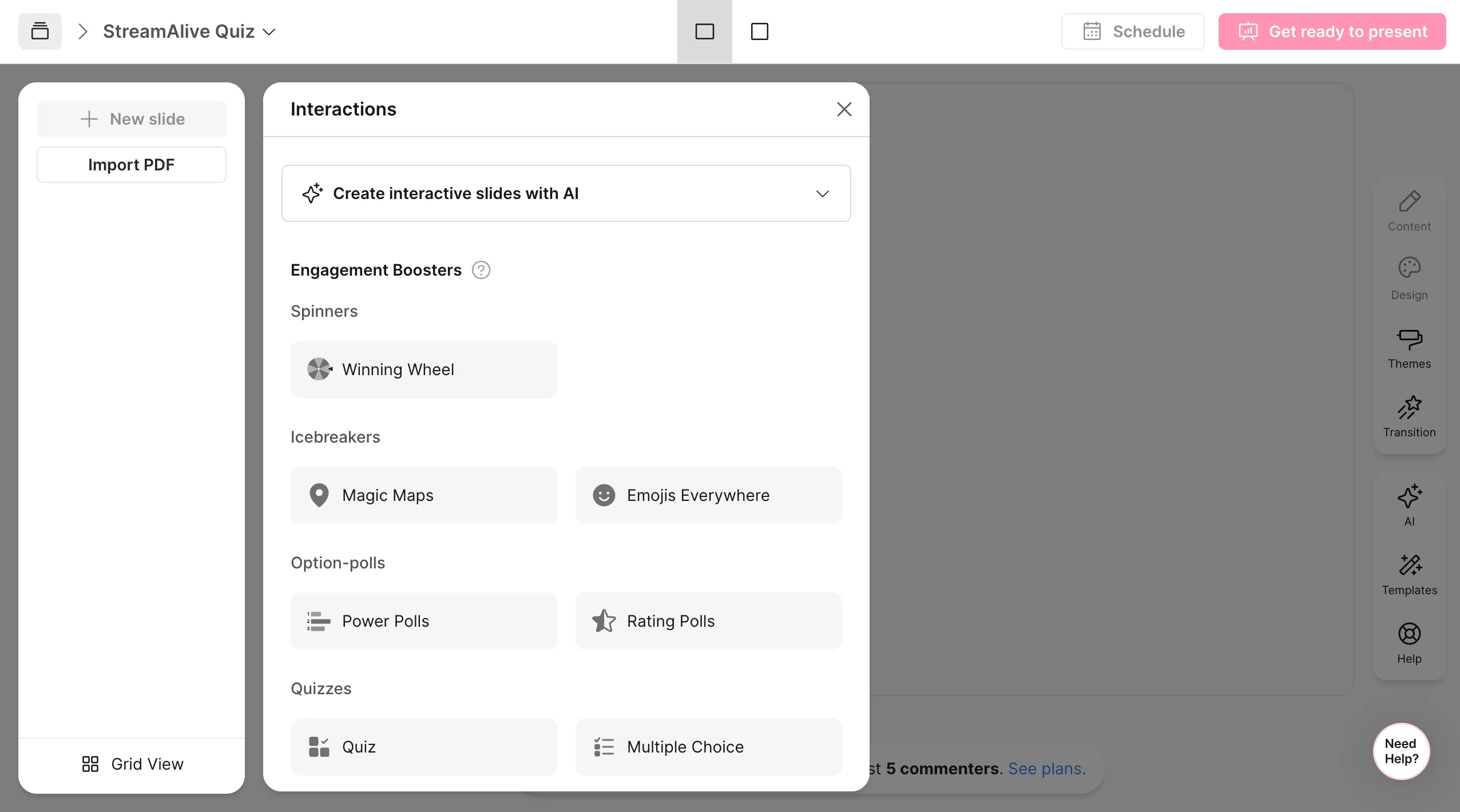
- What is: This is a tool that’s not a presentation so much as it is a layer that visualizes a live chat. You can do it in zoom, teams, meet etc — all you need is the chat box on your video call platform. They have a dozen or so specific options for what ways you can visualize: things like wordclouds, maps (”where are you calling in from?”), polls (type the number option you select in the chat, the screen will show the votes on the options), etc.
- Ratings: 4.7 on G2, 4.8 on Capterra, and we gave it a 7.1. Not many reviews out there yet (like a couple dozen total). People like not needing a phone or second window, people don’t like the audience caps on the cheaper plans.
- Standout feature: the chat thing. Responses come straight out of your zoom / teams / meet chat, nobody has to go anywhere or pick up their phone.
- Biggest drawback: free is basically a demo, you get 5 participants. Also it’s one presenter per account, and the team plans are enterprise-priced (thousands a year).
- The good: This is easy — your players need to know literally no thing, not even a QR code scan, they just can type stuff in the chat. You can add interactions as you go — don't need to plan anything in advance (though, if you want to, that’s possible as well with a deck-like builder, so, you’ll see ppt again here).
You can have an interaction where you just see what everyone typed in response to you, that’s nice and flexible. - The bad: This isn't really a lesson or game in itself — You don’t have a sandbox here, you’re just relying on the chat. If you want to make it feel more professional or official, this isn’t that. If you want it to be your own look and feel and event, if you want them to be able to, say “tap on an option” rather than type in the option, can’t do that either. it feels much more freeform, and much less “heres my presentation that I put together or you”.
- The AI: They have it. It’s pasted on like all the rest. the generated stuff is heavily compensated with their own provided questions (which is better but much more limited).
- What users say:
- “One of the best tools I know for interactivity on Zoom is StreamAlive (I am not affiliated) … it is able to fetch the answers from Zoom chat, no need for the pax to use another tool, and then display quiz results, wordcloud, maps, etc.” — r/facilitation
- “This post is just an ad. OP suddenly started shilling StreamAlive in a bunch of subs simultaneously.” — r/Professors - The pricing: First five people to type in the chat are visualized, each session. If you want to see more than those 5, it’s an upgrade. Large groups, just a few events? $100 gets you a pack of 4 sessions with up to 250 people, or it’s $25/mo, $300/yr billed yearly, for 4 sessions a month, then you’re knocked back down to free. If you’re running a ton of events, then it’ll be $75/mo, $900/yr for unlimited sessions, up to 1,000 people in each.
Kahoot Alternatives for Classroom
1. Wayground
Overall: Wayground is a strong teaching tool, with lots of premade content for teachers, sortable by grade level and topic. Students join in on a device either live or solo, for eg. assigned homework. It's one of the better teaching interactive quizzing platforms out there.
- Who for: Teachers. this is a teaching tool, clearly geared classroom-first.
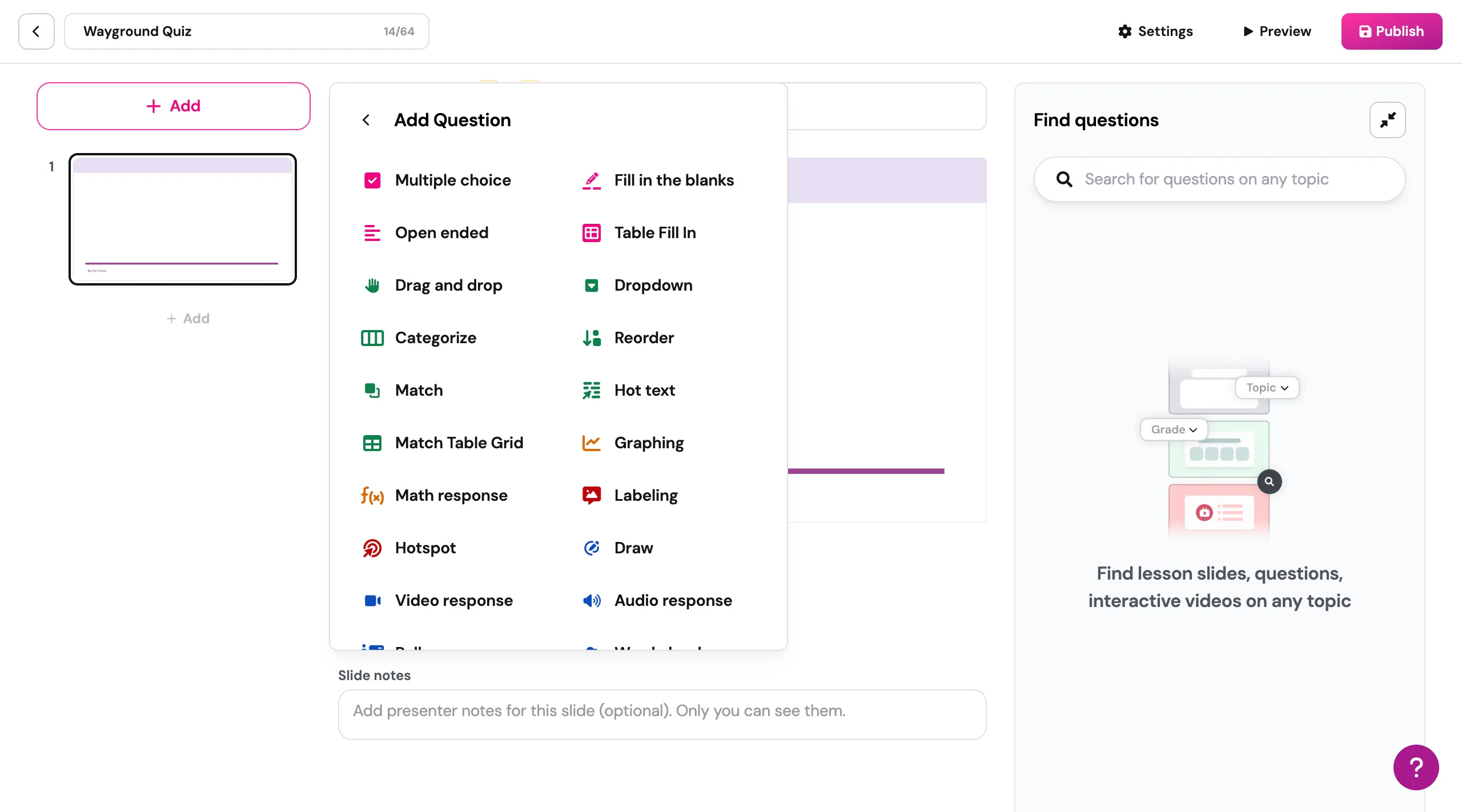
- What for: Basically this is for running lessons and assessments on a projector / shared screen, with a group of students who have phones/tablets.
You can build lessons, and there is a lot of ready-made content (some better some worse) that is organized by grade level and topic. (One of the ways you can see if a tool is right for you is to look at their template library — are they offering / showcasing things that apply to you?) - What is: This is a lesson-running platform. You can build decks, but they’re not really geared toward that, it’s more you using their pre-provided content. (And if you want more than 20 lessons stored in your account, you have to upgrade.)
- Ratings: 4.9 on G2, 4.8 on Capterra, and we gave it a 9.0. Teachers like how into it the kids get, and all the premade stuff. They don’t like the price, or that things keep moving behind the paywall. Reddit is mostly positive but there’s some real anger in there about the rebrand and the 20 lesson cap.
- Standout feature: student-paced. Everyone goes through the questions on their own device at their own speed, live in class or for homework, so you aren’t waiting around for stragglers. You can turn the timer off too. And this is all on the free plan.
- Biggest drawback: the 20 lesson cap. They used to not really enforce this, now they do. Once your library is full you can’t make or edit anything until you delete / archive something, or upgrade.
- The good: Been in the space for years (this used to be Quizizz), this is mature software that works, with lots of teachers using it. If you run out of lesson planning time, you can pop in here and grab something. Be careful of course, there are quizzes and lessons that are very meh, it takes some sorting time to find the good ones.
- The bad: There’s a lot going on here, so there’s a bit of learning curve for first-time users. I wouldn’t send any professed “non tech savvy” teachers here, if they asked me.
- If you’re leaving Kahoot for the bloated feeling, this isn’t your first choice.
- For the assessment portions: Design wise you can’t do much, so if you want this to look a certain way — sorry, it’s going to look like Wayground. for presentations, you have a little more power. - The AI: They have implemented some “auto generation” tools that feel a little pasted-over the existing tool, but they’re definitely making moves. Best is the “generate deck” option where you can give a prompt and select some settings and it will spit out a quiz for you. But be careful and check these — they’re not burning high-end tokens for this, so the questions can be pretty mediocre.
- What users say:
- “I like Wayground because I don’t have to wait for the stragglers and slowpokes to join to start the game.” — r/Teachers
- “I use Quizziz (now Wayground). Some of it's behind a paywall but the basics - especially seeing how well each kid did - is still available. It does suck that you can only have 20 "quizzes" at a time but if you just delete when done it seems to work okay.” — r/Teachers - The pricing: For teachers single-use, it’s free, for up to 100 students per session. You can have up to 20 of your own lessons. You can use as many of the premade ones as you like, but if you want to edit them, they’ll count against your library’s total. So, if you want more decks than 20 in your library, more than the most basic interaction types (you can do like, MC, text questions, polls and wordclouds, 10 types in all, otherwise you gotta pay), multiple different classrooms to assign work to, some stuff they call “Anti-cheating” that basically turns off the ability to right click, and copy/paste in the browser — They’re gonna push you to try to set up a school-wide or district-wide account (like, “put us in contact with your administration!”), which is part of a larger “land and expand” marketing strategy. but anyway. you can still get an individual plan for $18/mo, $216/yr billed yearly.
2. Slides With Friends
Overall: Yes, Slides With Friends again (the full rundown is up top). For the classroom, it’s a top option for “Kahoot but better”. You can do all the quizzes and polls same same, but it’s built like a slide deck — like, make your static slides, lay them out, style them, etc. Then add your interactive elements. Your lesson & your pop quiz are in one spot. Big rec.

- Who for: Teachers, professors, TAs — anyone who’d teach from PowerPoint or google slides, but wants the class to join in instead of just watch.
- What for: Lessons, pop quizzes, review games before a test, class icebreakers, etc. If you’re teaching live and want to engage your students, have them retain information better, and enjoy the process, this is a good option.
- Ratings: Same tool, same scores as above: 4.8 on G2, 4.9 on Capterra.
- Standout feature: speed doesn’t win. You set the points for a question, a timer is optional, and speed is only the tie breaker. So it’s about knowing the answer, not being the fastest.
- Biggest drawback: Same as above, 10 players before upgrade. Your class is probably bigger than that, so it’s teams on shared devices or the paid plan.
- The good: It’s maximally flexible, and the prettiest option out there. There are ready-made classroom decks you can grab if you’re out of prep time (like a quiz template, a class icebreaker, or a Romeo & Juliet reading quiz). And students just scan a QR code to join, no downloading anything.
- The bad: It’s live only, there’s no homework / self-paced mode, and we don’t integrate with Google Classroom or Canvas. There are some PPT features missing like animations and drawing.
- What users say:
- “Slides With Friends is fun one to use, but it’s more casual and less structured for reflection-heavy lessons..” — r/edtech - The pricing: Free for up to 10 players. For teachers it starts at $6/mo billed for the year, for up to 50 students (you have to make a “School” account to see the edu prices).

3. Blooket
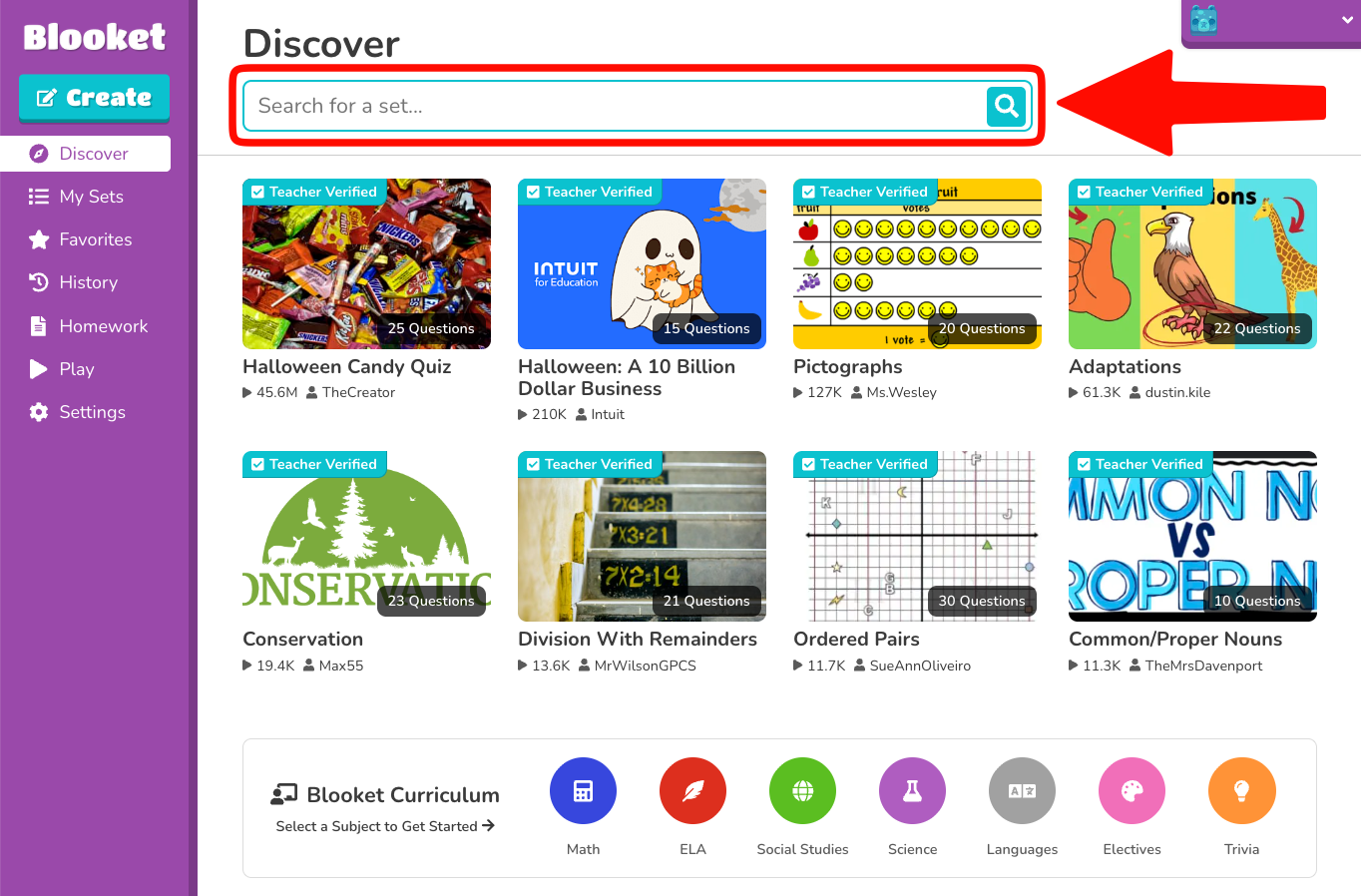
Overview: Blooket is a mix between a light gaming platform and an interactive quiz. They have a set of game styles (you might recognize many from popular apps) — things like “Café” where you answer questions correctly to serve up toast to hungry customers, “tower defense” where you buy (by answering questions correctly) artillery towers to defend a map, “fishing frenzy” where you cast your rod with correct answers, and more.
You enter, upload, or find a pre-made question set related to your topic / study guide. Educators then can either launch games live in classroom, or assign them as homework. When playing live, students see & play the game on their device, while the teacher’s screen displays the leaderboard. Or homework allows students to pick their own game style.
- Who uses it: This is for teachers of younger students, elementary / middle school.
- What’s it for: material review. It’s like multiple choice flashcards paired with a motivating gameplay format.
- Ratings: 4.9 on G2 (only 14 reviews though), not on Capterra. Teachers on Reddit like it a lot, their kids ask to play it. The gripe is students clicking random answers to get back to the game.
- Our rating: this is a fun game. If your goal is to review a set of standardized multichoice questions in a gamified way that students enjoy, this is a good bet. Plus it will certainly get you as a teacher some quiet time in the classroom (to tackle the 400 other things you need to do).
- Standout feature — the games. It’s a cool implementation of the little games that so hook children, combined with teacher-curated quizzing and review.
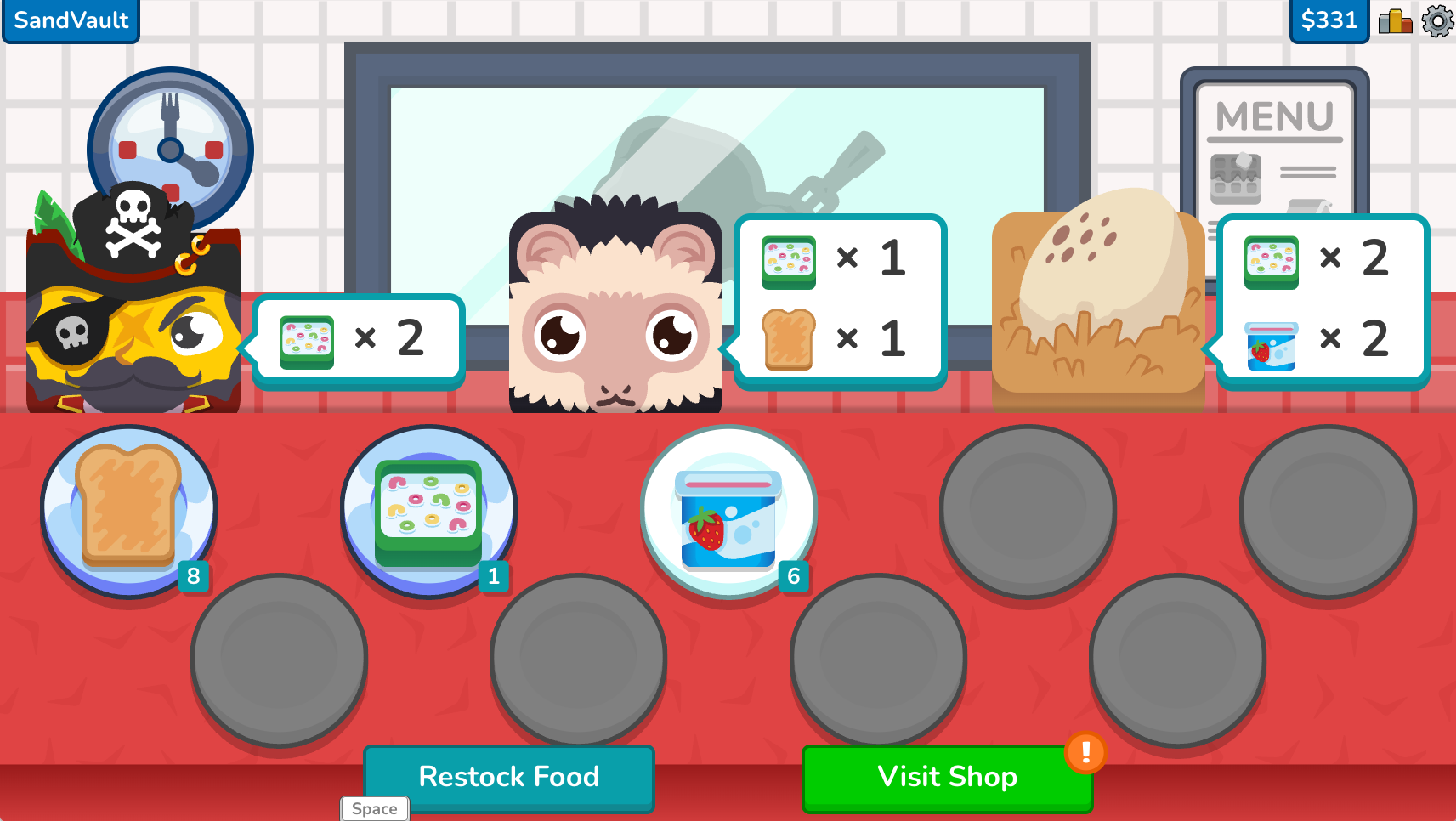
- Biggest drawback — is this real learning? gosh who’s to say. It’s certainly screen time.
- What’s it good for: Flashcard type study, pre-created content from other teachers, easy-to-build your own question sets or import them, and quick to make sets. Once your set is made, you can use it with any game style.
- What’s it not good for: Interactive presentations like Kahoot — it’s more gaming and less presentation. So think less lesson, more game.
- User quotes from reddit: “I said it. I think Blooket has much better free options and is a lot more engaging than Kahoot.” (r/Teachers) / “My kids love Blooket, but ever since I realized some were randomly clicking answers to get to questions they knew, I’ve only been doing Kahoot. However, I pay way too much for Kahoot.” (r/Teachers) / “The “winner” is inflated by stealing and cheating options, so I grade based on the percentage of questions correct.” (r/Teachers)
- Pricing: You can do a lot for free: unlimited question sets, live games up to 60 players, and most of the game modes. Blooket Plus is around five bucks a month (billed for the year) for bigger groups, the rest of the game modes, per-student reports, etc. They have group plans for schools too.
4. AhaSlides
Overall: AhaSlides was originally a pretty close clone of Mentimeter, out of Singapore. Since then they’ve added their own special sauce and went more “fun & engagement” and less “tool”. The key point here is: it’s cheap. If your main pain point with Kahoot is pricing, this is a really good alternative option.

- Who for: Teachers / lecturers, trainers and meeting facilitators. Their terms say 16 and up, so this is for older students, I wouldn’t throw it into an elementary classroom.
- What for: Interactive lessons, lectures, workshops, quick class check-ins. There are polls, wordclouds, quizzes, Q&A, and a spinner wheel for picking names or options.
- Ratings: 4.7 on G2, 4.6 on Capterra, and we gave it an 8.5. People like how quick it is to make a poll or quiz your first time in. People don’t like how little you can customize, or paying for a year when they only use it here and there.
- Standout feature: the integrations are all free. PPT, google slides, Teams, zoom. So you don’t have to rebuild your deck in here, you just add interactions to the one you have.
- Biggest drawback: The free audience allowance looks generous (50 people), but the question limit is the catch. And I can’t tell you exactly what the limit is because their own pages say different things. Try it in your account before you plan a lesson around it.
- The good: Since it’s basically Mentimeter, if you’re coming from there, you’ll be immediately familiar with the UX/UI. It’s your classic “ppt meets interaction” platform, though not as designable as Slides With Friends or as robust as Mentimeter. You get a lot for free though, like self-paced mode (so you can send a quiz home), co-editing, and you can turn off the speed bonus.
- The bad: Quiz questions always have a timer. You can make it really long, but you can’t turn it off. Exporting results is an upgrade. And I didn’t see a FERPA or COPPA statement, so if your district vets tools, ask first.
- What users say:
- “I use Ahaslides for taking attendance that’s used with a QR Code at the beginning of class. I also use Ahaslides for presenting the material and for assessment during the class to check for understanding.” — r/Professors
- “I use an interactive ppt called Ahaslides to do in-class quizzes and fun activities which they have tried *so hard* to force it down user's throats to generate... ppts? like stupid sh!t such as "Game of Thrones quiz" lmao.” — r/edtech - The pricing: Free for up to 50 participants at a time, with unlimited presentations (but, the question limit). For teachers it’s super cheap, around three bucks a month billed for the year for 50 students and unlimited questions. Not a teacher, it starts at $7.95/month, billed annually, for 100 participants; monthly subscriptions are also available.

5. Gimkit
Overview: Gimkit is like Blooket for older kids. Students answer questions on their own device, and the correct answers earn them cash / energy to spend inside a multiplayer video game (capture the flag, a climbing race, fishing, and more). It was started by a high school student who wanted a game he’d want to play in class.
- Who uses it: Middle and high school teachers, mostly. Vocab, world languages, history facts, quick-recall math.
- What’s it for: material review, same as Blooket. Live in class is free, homework is an upgrade.
- Ratings: Not on G2 or Capterra that we could find, so this is all Reddit. Teachers there like it, “students love it” comes up a lot.
- Standout feature — the 2D modes. These are real video games: students run around a map as little blob characters (“Gims”) and have to answer questions to earn energy / bait / snowballs to keep playing.
- Biggest drawback — the game can take over. One teacher on Reddit had 7th graders answer four questions and then chase each other around for 5-10 minutes. There’s a setting to fix this (make each question worth less), but you have to know to do it.
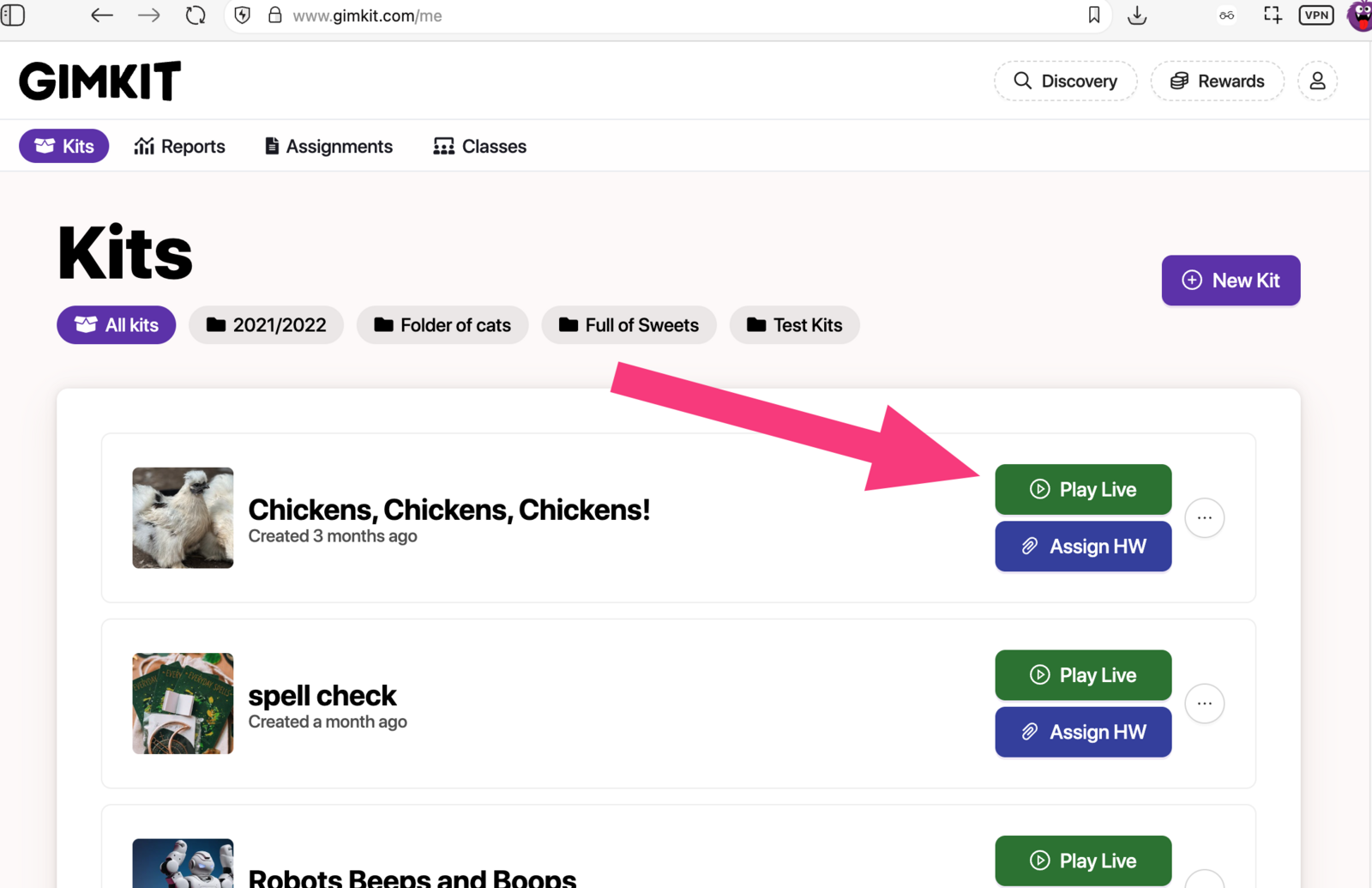
- What’s it good for: Quick to set up. Students join with a code, no account. Question sets (they call them “Kits”) are easy to make or import, or grab one from another teacher, or have AI make it, or have your students write the questions which is kind of cool. You get a report after every game too.
- What’s it not good for: Anything deep. It’s multiple choice or typed answer and that’s it. And like Blooket, this is a game, not a lesson / presentation.
- User quotes from reddit: “I love Gimkit! … it is very similar to Kahoot, but answering the question gives you energy for individual or team games like Capture the Flag or Sharks & Minnows …” (r/Teachers) / “Gimkit doesn't make the students answer as many questions in between game modes - Blooket seems to be the better option in my opinion. And they are both better than Kahoot.” (r/Teachers)
- Pricing: Free gets you unlimited games with big groups (500 students, or 60 in the 2D modes). The catch is you only get a few game modes at a time and they rotate. Pro is about sixty bucks a year for all the modes, homework, etc. There’s a whole-school plan for a grand a year.

Prices & Best Free Options
If you’re here because Kahoot got too pricey, that’s fine, there are so many options. Long story short, if you want to get around some of those free-tier limitations of Kahoot without a single upgrade — I bet you can. So, those looking for truly free, this table is for you.
Here’s a full list of what you can do where, and which tools have the best free options.
Limits of free Kahoot Alternatives
| Software | What can I actually do for free? | Free plan rating | Players per event | Interaction limit per deck | Main feature limits |
|---|---|---|---|---|---|
| Kahoot! | Basic quizzing for one class | 85 out of 100 | 40teachers; 10 on personal accounts | 2 question typesquiz and true/false, up to 4 answers |
|
| Slides With Friends | As many small events as you want | 85 out of 100 | 10 | Unlimited slidesall interaction types |
|
| Wayground | 20 custom lessons, only two question types | 70 out of 100 | 100per session | 2 question typesmulti choice and polls |
|
| Blooket | 13 game modes with two question types | 90 out of 100 | 60per game | 2 question typesmulti-choice and typed answer |
|
| Mentimeter | If you only need the live events and not post-event results | 65 out of 100 | Unlimitedparticipants, limited results | 200 slidesper presentation, 23 slide types |
|
| Slido | Events with 3 polls or less | 85 out of 100 | 100per slido; adds up if you reuse it | 3 polls + 1 quizper slido |
|
| AhaSlides | Medium size events, with 2 interactions max | 95 out of 100 | 50connected at the same time | Only 2 interactive slides per deck |
|
| Poll Everywhere | Polls for a medium-sized group | 90 out of 100 | 40audience size | Unlimited questionsevery question type |
|
| Gimkit | Unlimited players on 3 free game modes | 75 out of 100 | Unlimitedin free modes; 5 in Pro modes | None listed |
|
| StreamAlive | Run a Zoom call with 5 visualized chats | 60 out of 100 | 5visualized chats per slide | Every interactionnone locked |
|
Or, if you’re looking for an organization / multiple host set up (did Kahoot limit your usage from different IPs?) there are a lot of cheaper multi-user options out there. Some of our personal recommendations are Slides With Friends (multi-user team accounts start from $99/month) and Slido (which offers team setups pretty easily).
If you’re price comparison shopping, and want to know which tool can get you the biggest bang for your buck, here’s how each platform compares. I would call out AhaSlides for being one of the cheapest options, and Slides With Friends for the best value for your $.
Kahoot pricing and alternatives
| Software | Free plan (players) | Cheapest paid plan, teachers | Cheapest paid plan, work | Players on that plan | Teams / multi-host | One-time / single-event option |
|---|---|---|---|---|---|---|
| Kahoot! | 40per game, teachers; 15 for work | $3/mo$36 billed yearly | $15/mo$180 billed yearly | 50 | Work: $20/mo per host, 25 hosts minimum. Schools: quote | From $199 per event (200 players, 30 days) |
| Slides With Friends | 10per event | $6/mo$72 billed yearly | $8/mo$96 billed yearly | 50 | Custom (Enterprise team account, contact us) | Yes: 30-day pass from $35 (50 players), $99 for 250 |
| Wayground | 100per session | $18/mo$216 billed yearly | $75/mo$900 billed yearly | 1,000teachers; 150 work | Schools: quote. Work: the $900 plan covers up to 3 seats | No |
| Blooket | 60per game | $4.99/mo$59.88 billed yearly | No work plan | 300(60 in racing and team modes) | 10 teachers for $550/yr, up to 80 for $3,000/yr | No (monthly plan, $9.99) |
| Mentimeter | Unlimitedlimited results (accounts before 4 Nov 2026: 50 a month) | $11/mo$132 billed yearly | $14/mo$168 billed yearly | Unlimited | Per presenter. Team features on Pro: $28/mo work, $17/mo teachers | $350 for 30 days (up to 4 presenters) |
| Slido | 100per slido | $7/mo$84 billed yearly | $17.50/mo$210 billed yearly | 500teachers; 200 work | Co-hosts free on every plan. Extra members $17.50/mo each (up to 5) | $60 per event (7 days, 200 players) |
| AhaSlides | 50at the same time | $2.95/mo$35.40 billed yearly | $7.95/mo$95.40 billed yearly | 50teachers; 100 work | 2 to 30 licences, up to 20% off | No (monthly plan, $23.95) |
| Poll Everywhere | 40responses per activity | $9/mo$108 billed yearly | $10/mo$120 billed yearly | 700 | Extra presenter $120/yr each. Shared polls: Enterprise, custom | $499 per event (1,000 audience) |
| Gimkit | 500per game in free modes (60 in 2D modes); 5 in Pro modes | $4.99/mo$59.88 billed yearly | No work plan | 500(60 in 2D modes) | 20 teachers for $650/yr; whole school $1,000/yr | No (monthly plan, $14.99) |
| StreamAlive | 5per session | Not published | $25/mo$300 billed yearly | 1,000per session, 4 sessions a month | From $5,000/yr for 3 or more presenters | $100 for 4 sessions (250 players each) |
Features: what can each platform do
Each tool is different and takes its own special spin on the genre. I love how Blooket is a world away from Slido but are still both in the “audience response” field. So I’ve pulled out some of the most-common requests we get, and made a table of exactly what each platform does and doesn’t offer — and how well.
Full feature comparison table for alternatives
| Software | Platform Vibe | Interaction Types | Group Engagement | Player Presence | Branding | Designability | Anonymous Play | Spectator Play | Collaborative Editing | Presenter Tools | Moderation | Untimed Scoring | Tie Breaking | Analytics & Export | Templates | Integrations | Self-Paced (Homework) | AI Features | Company Location |
|---|---|---|---|---|---|---|---|---|---|---|---|---|---|---|---|---|---|---|---|
| Kahoot! | Games for kids | 4 of 18 interaction types are free | Yes | Yes | Paid | Partly | Yes | Unconfirmed | Paid | Partly | Yes | Yes | Unconfirmed | Partly | Yes, a stand-out | Partly | Yes | Partly | Oslo, Norway |
| Slides With Friends | Fun but professional, totally flexible | 11 of 11 interaction types are free | Yes, a stand-out | Yes | Paid | Yes, a stand-out | Yes | Paid | Quote | Yes, a stand-out | Yes | Yes | Yes, a stand-out | Partly | Yes | Partly | Not offered | Not offered | Delaware, USA |
| Wayground | Playful school lessons | 11 of 25 interaction types are free | Partly | Yes | Quote | Yes | Yes | Unconfirmed | Partly | Yes | Yes | Paid | Unconfirmed | Yes | Yes, a stand-out | Yes | Yes, a stand-out | Yes | Santa Monica, CA, USA |
| Blooket | Straight up gaming | 20 of 25 interaction types are free | Partly | Yes | Unconfirmed | Partly | Yes | Unconfirmed | Unconfirmed | Partly | Yes | Partly | Unconfirmed | Partly | Yes, a stand-out | Partly | Yes | Partly | Pending |
| Mentimeter | Corporate presentation | 12 of 12 interaction types are free | Yes | Yes | Paid | Partly | Yes | Partly | Paid | Yes | Paid | Yes | Unconfirmed | Partly | Yes | Yes | Partly | Yes | Stockholm, Sweden |
| Slido | Corporate Q&A forms | 8 of 9 interaction types are free | Partly | Partly | Paid | Paid | Yes | Unconfirmed | Paid | Yes | Yes | Unconfirmed | Yes | Paid | Yes | Yes | Paid | Yes | Bratislava, Slovakia |
| AhaSlides | Playful version of Mentimeter | 44 of 44 interaction types are free | Yes, a stand-out | Yes | Paid | Yes | Yes | Partly | Yes | Yes | Yes | Yes | Not offered | Partly | Yes | Yes | Yes | Yes | Pending |
| Poll Everywhere | Old-school corporate | 9 of 10 interaction types are free | Partly | Partly | Paid | Partly | Yes | Unconfirmed | Quote | Yes | Partly | Yes | Unconfirmed | Partly | Unconfirmed | Yes | Partly | Yes | San Francisco, CA, USA |
| Gimkit | Playful game-like | 3 of 10 interaction types are free | Partly | Yes | Unconfirmed | Partly | Yes | Partly | Partly | Partly | Yes | Partly | Unconfirmed | Yes | Yes | Partly | Paid | Unconfirmed | Seattle, WA, USA |
| StreamAlive | Zoom chat visualizer | 11 of 11 interaction types are free | Yes | Partly | Paid | Partly | Yes | Unconfirmed | Paid | Yes | Unconfirmed | Unconfirmed | Unconfirmed | Yes | Yes | Yes | Not offered | Yes | Basking Ridge, NJ, USA |
FAQs for Corporate use
What’s the best Kahoot alternative for adult learners and professional training? I want to do trainings for my team.
— Slides With Friends — biased because I’m building it, sure, but we literally designed it to make training stick and give you real data out of it (we helped Aetna improve performance doing this). If you’re wearing hard pants to this training and emoji just isn’t the right vibe — or you need an LMS integration — may I suggest Mentimeter. And StreamAlive if you’re training over zoom and just want everyone staying in the chat.
What’s the best way to bring interactivity into my PPT slide deck?
— Two ways to do this. If you want to stay inside PowerPoint, Slido, Poll Everywhere, and AhaSlides all have a ppt add-in you can use for free. Or go the other way and pull your deck into Slides With Friends, then drop your polls / quizzes / whatever right in between your slides. Whole presentation in one spot, no more flipping back and forth.
Can our trainers share, reuse, and brand content consistently?
— Yeah, though pretty much everyone makes you upgrade for the full setup. Mentimeter has the most built out here — shared workspaces, templates, co-editing, branding — you’re paying per presenter though, which adds up fast. AhaSlides actually lets you co-edit for free, which is nice. With Slides With Friends you can pass decks back and forth between accounts on any plan, and if you’re on a team account everyone shares a library (plus full branding / theming, so it actually looks like your slides and not ours).
I want to run a live poll. Best tools?
— Depends on what else is happening in the room. If you want “polling plus” — serious data gathering, SMS voting, just pop in and get the numbers without building a whole deck — Poll Everywhere. If the polls are part of a bigger presentation alongside your slides and everything else, Slides With Friends. And Slido if you’re mostly running a Q&A and just want a couple polls on the side.
What’s the most reliable / consistent tool? I don’t want to be stranded in a live event.
— I’d say Slido or Poll Everywhere — they’re mature software, both have public status pages, and Poll Everywhere has been at this forever. It just works. That said, don’t trust any of us blindly before a big event. Run your actual deck ahead of time on a couple phones using the wifi you’ll be on, and keep the join link handy in a tab just in case. It’s all planning.
We have one big all-hands meeting a year. What’s the most cost-effective option?
— We do one-time passes at Slides With Friends for exactly this — thirty days, no subscription to forget to cancel, starting around $35 for 50 players. Slido and StreamAlive have one-off options too, more in the sixty to a hundred buck range. Pretty much everyone else’s event plans start around a couple hundred bucks and go up from there.
What integrates best into PPT, Google slides, Teams, Zoom?
— Menti and Slido are the big names here, and honestly Slido’s better at it — ppt, google slides, Teams, zoom, all of it works on the free plan. Menti still doesn’t have a google slides add-in, which surprises people. AhaSlides covers all four too, and Poll Everywhere throws in Keynote, Webex, and Slack if you’re in that world. With Slides With Friends it’s a different setup — you import your ppt or google slides into our deck builder rather than running it as an add-in.
I want employees to join without having to mess around with logging in to an account or downloading things. What’s my choices?
— If you want zero joining at all, StreamAlive — your people need to know literally no thing, not even a QR code scan, they just type in the video call chat. For pretty much everything else on this list (Slides With Friends, Slido, Menti, etc) it’s just a QR code or link that opens in their phone browser. No app, no account, no hassle.
I want to know how employees are performing over time — how can I track their learning?
— This is actually one of my favorite things we built into Slides With Friends — you can follow individual people across events over a month, a quarter, a year, and see their accuracy, attendance, participation, all of it. It does take a paid plan. AhaSlides has a participants report on their higher tiers too. With Mentimeter or Slido you can export per-person results, sure, you’ll just be stitching spreadsheets together yourself after the fact.
I want to get usable data — measure understanding and get useful training data. What tools have the best analytics?
— If you want it broken down per person across sessions, Slides With Friends — you get real tracking on how folks are doing over time and you can export all of it once you’re on a paid plan. Poll Everywhere is great if you just want the raw numbers out (though any reporting there requires an upgrade, and it’s not cheap). Mentimeter will export to Excel too if you’re paying.
What’s best for anonymous feedback?
— Slido or Mentimeter — both are anonymous by default. Slido especially is your jam for a big town hall where nobody wants to be the person raising their hand with the awkward question, since people can submit and upvote stuff with no name attached. Poll Everywhere works too. We do have an anonymous mode in Slides With Friends, it’s just an upgrade.
I want to assign self-paced training or a post-training review. Best tool?
— AhaSlides. You can flip any deck to self-paced and send out the link, even on the free tier. Mentimeter and Poll Everywhere can collect async responses too. Skip us and StreamAlive for this one — Slides With Friends and StreamAlive are live only.
Which US-based alternative meets our security and procurement requirements?
FAQs for the Classroom
I’m a teacher who can’t afford Kahoot — what’s actually free for my whole class?
— Depends on what you’re doing obv, but the fullest featured, truly freemium options are AhaSlides and Blooket. You can do a lot for free in both. The education content in Blooket is better; the flexibility in AhaSlides is higher (though AhaSlides caps how many interactive questions you get per deck on free). Blooket takes up to 60 players free, AhaSlides up to 50 — if you’ve got a bigger class, Wayground lets you go up to 100.
What’s the best straight quizzing platform?
— Favorites are Wayground and Slides With Friends (super flexible and designable quizzing — you can build your quiz like a slide deck) for classroom competition. I also like Mentimeter and AhaSlides for ppt-esque quizzing. If you want more of a flashcard / game feel, Blooket. I wouldn’t pick Slido as first choice here. Though, all the tools I’m reccing here can do “quiz” functionality in some shape or form.
I want to assign homework, what’s the best student-paced tool that’s usable by participants at home / any time?
— Wayground if you want actual lessons and quizzing / review assignments they can do solo at home, with tracking built in. Blooket for more gamified review. Both let you assign homework for free. Gimkit makes you upgrade for it, and we’re live only over at Slides With Friends, so we’re out for homework.
I want an untimed quiz (Kahoot only lets me do timed competition). What are my options?
— With Slides With Friends you can run questions totally untimed / unpaced, or throw a timer on when you want one. Wayground lets you switch the timer off too. AhaSlides won’t do it — quiz questions there always have a timer running.
I don’t want to reward answers based on response speed, what tools don’t care about how fast you send in an answer?
— Slides With Friends doesn’t force speed scoring — you can just ask for responses without turning it into a race. Wayground works if you turn the timer off, and AhaSlides has a “Faster answers get more points” box you can uncheck. (To be fair, Kahoot does have an Accuracy mode too.)
I want to run a live classroom pop quiz where everyone participates. What’s the most exciting tool?
— Slides With Friends for group learning events and live pop quizzes, plus the fun / silly stuff like emoji avatars, soundboard reactions, and more. Wayground is good too, just a lot more standardized — it’s going to look and feel like Wayground. And Blooket if you want a super gamified thing younger students can get deeply into (just FYI, they’ll be glued quietly to their own screens rather than looking up at the room).
I want to upload my Kahoots into another tool. Do any tools do that?
— Not in one click, sadly — nobody has an “import from Kahoot” button, and Kahoot isn’t exactly rushing to give you an export button either. The workaround is a little clunky: run your kahoot once, download the report (it spits out a spreadsheet with all your questions and answers), and upload that into the new tool. Wayground, AhaSlides, Blooket, and Gimkit all take spreadsheets, though you’ll have to do a bit of reformatting first.
My students are bored of Kahoot but I want similar functionality. What’s fun?
— Blooket is fun. Gimkit is fun. Slides With Friends is fun and more purposeful. Wayground is learning with some gamified elements on top. Generally: Blooket for younger kids, elementary / middle school, and Gimkit for older.
Can I ask open-ended questions and use longer, more complex questions? Kahoot limits characters and doesn’t have type-in-text responses on my tier.
— Yeah, pretty much everyone is better about this than Kahoot. Slides With Friends gives you text answer questions on the free plan, and you can even let players vote on each other’s answers (always gets good laughs). Wayground has open-ended questions for free too. Mentimeter, AhaSlides, Poll Everywhere — they all do it.
How can I save prep time / reuse content I’ve already made?
— Wayground, easy. There’s a massive library of premade stuff sorted by grade level and topic, so if you run out of lesson planning time you can pop in and grab something (just be careful, some of it is very meh and takes a little sorting). Their AI will also turn a pdf or worksheet you already have into a quiz, though definitely read it over before you put it in front of kids. Blooket has a ton of teacher-made sets too. Or if you’re starting from slides you already built, AhaSlides imports ppt — and we’ve got ppt import plus ready-made classroom decks in Slides With Friends you can copy and tweak.
What options integrate with Google Classroom, Canvas, or the slides I already teach from?
— Wayground is the move for Google Classroom — Canvas and Schoology too, though they lock those behind school plans. If you just want to stay inside the slide decks you already teach from, AhaSlides and Poll Everywhere both plug into ppt and google slides. Blooket, Gimkit, and Slides With Friends don’t connect to an LMS at all, so cross us off if that’s a dealbreaker.
Which options are allowed in my school?
— This is really up to your district, not the software, so definitely check before you spend an hour building anything. Most schools have an approved app list and care about COPPA / FERPA and whether kids need accounts. Wayground and Gimkit both say they’re FERPA and COPPA compliant, and with Blooket, Gimkit, and Wayground students can join without making an account. Heads up that AhaSlides is 16 and up. On our end, we don’t have a FERPA / COPPA statement for Slides With Friends — we didn’t really build it for under-13s.
Try out some alts right now
Kahoot alternatives you can use right now — quiz templates and ready-to-play classroom games. Here are some interactive quizzing templates you can use immediately, for free with small groups.
Ok that’s all. I hope this was helpful. If you’re still undecided, my overall top choice would be Slide With Friends. It’s the most flexible, most designable, and most Kahoot-esque alt (but cheaper and without all the clutter).





More related articles



Ready to ditch the dull, and run team sessions that people will actually enjoy?
Get started with a Slides with Friends deck in no time. We’ve got all the interactive features you need in one easy-to-learn, easy-to-set-up tool.